


Selling food supplements on Amazon UK can be profitable, but this is not a category in which you should order stock first and solve compliance later. You are selling a regulated food product through a marketplace that can ask for labels, invoices, safety records and testing documents at any time.
This guide explains how to sell supplements on Amazon from first product idea to launch and growth. It covers research, manufacturers, UK food law, Amazon compliance, listing creation, FBA and FBM, fees, advertising and brand protection. The main focus is human food supplements sold on Amazon.co.uk; pet supplements are explained separately where the rules differ.
1. Is Selling Supplements on Amazon Profitable?
Supplements have several attractive commercial characteristics. Products are usually compact, relatively light and suitable for repeat purchase. A customer who is happy with a 30- or 60-day supply may reorder, and an eligible product may eventually benefit from Amazon Subscribe & Save.
That does not make every supplement profitable. Popular searches attract established brands, aggressive advertising and large numbers of similar private-label products. Compliance work, testing, packaging, VAT, Amazon fees and pay-per-click advertising can consume more of the selling price than a beginner expects.
The opportunity is strongest when you can answer four questions convincingly:
- Is there continuing customer demand rather than a short-livedtrend?
- Can the product stand out without using unlawful or unsupportedhealth claims?
- Can it retain a sensible profit after all costs, includingadvertising?
- Can you fund a reorder before the first production run hascompletely sold?
The main supplement business models
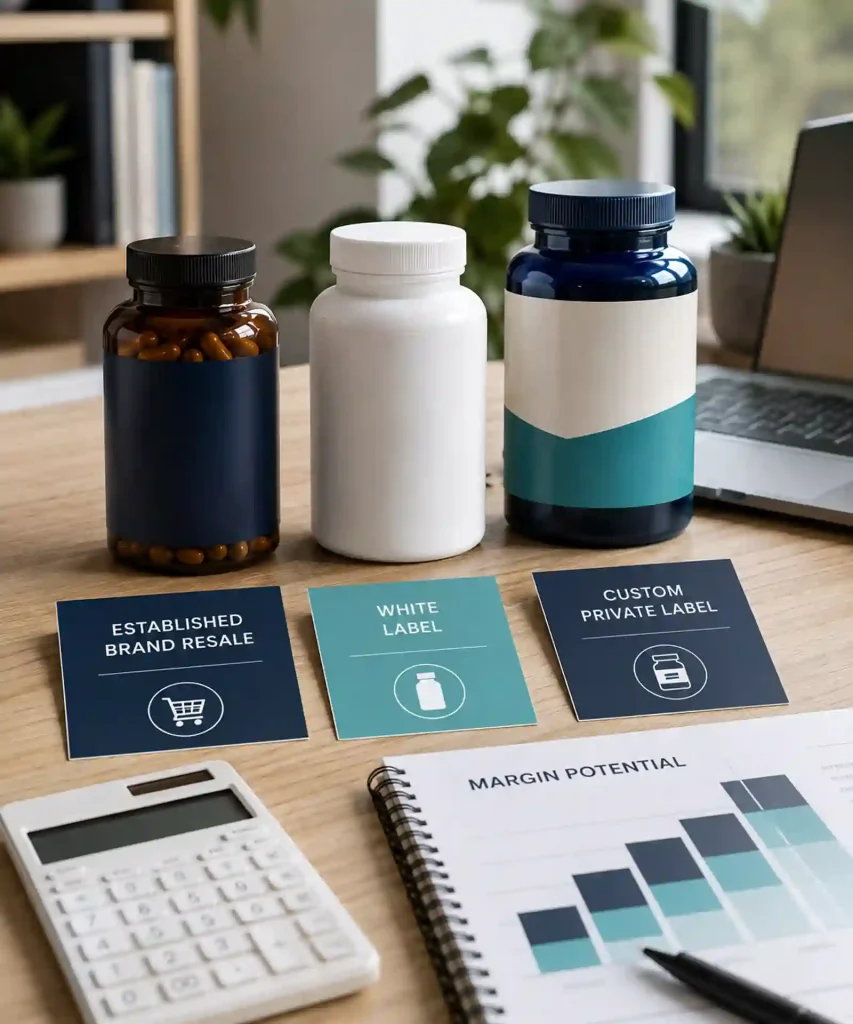
Reselling established brands is the quickest route. You buy genuine stock from the brand or an authorised wholesaler and sell on an existing Amazon detail page. Entry costs may be lower, but you share the listing with other sellers, compete for the Featured Offer and may be asked for supply-chain invoices. Confirm that the supplier permits marketplace resale and keep fully referenced commercial invoices.
White-label supplements are standard products made by a manufacturer and sold under your branding. This can reduce development time and minimum order quantities, but competitors may sell an almost identical formula. Your advantage must come from positioning, packaging, customer service and marketing rather than a unique recipe.
A custom private-label formulation gives you more control over ingredients, dose format and differentiation. It normally requires more development, larger production quantities and more testing. It can create a stronger long-term asset, but only if the formula and claims are compliant and demand is proven.
Contract manufacturing for an existing audience may work when a creator, practitioner or retailer already has customers. Amazon then becomes one sales channel rather than the entire business.
Can you sell supplements on Amazon without creating your own brand?

Yes. You can resell genuine, compliant products if Amazon permits the product and you are authorised to sell it. You do not need to own the brand simply to make an offer on an existing ASIN, but the listing must match the product exactly.
Do not buy retail clearance stock and assume a receipt will satisfy Amazon. Amazon may request invoices showing the supplier, purchaser, quantities and recent supply chain. Brand owners can also use distribution agreements, intellectual-property rights and Amazon tools to challenge unauthorised or inauthentic stock.
For a business you can control and eventually sell, owning the brand is usually more defensible than depending entirely on other companies’ listings.
2. How to Sell Supplements on Amazon UK – Step by Step

Step 1: choose a customer problem, not a miracle promise
Begin with a defined audience and purchasing situation: for example, adults seeking a convenient permitted source of a nutrient, sports customers comparing formats, or customers who dislike swallowing large tablets. Avoid building an idea around treating a disease. A food supplement cannot be presented as a medicine.
Create a shortlist by examining:
- Amazon search suggestions and related terms;
- best-selling products, prices, pack sizes and formats;
- review volume and recent review velocity;
- recurring complaints in two-, three- and four-star reviews;
- whether one or two brands dominate the first page;
- the quality of existing images, labels and explanations;
- seasonality and external search interest;
- the number of sponsored placements required to gain visibility.
Step 2: research keywords and search intent
Group keywords by what the shopper wants. A broad ingredient phrase may have volume but weak buying intent. A longer phrase containing the format, quantity or intended permitted benefit can be more useful.
Record the main term, close variants, format terms, audience terms and questions. Then check whether the search results actually show supplements comparable to your proposed product. Do not force a high-volume keyword into a listing if it describes a different ingredient, strength or purpose.
Keyword tools can estimate volume and competition, but Amazon’s own search results remain essential. Note the organic results, sponsored density, typical price, review count and how well each listing satisfies the query.
Step 3: study competitors commercially
Create a simple research sheet for the leading 15–20 relevant ASINs. Record selling price, unit count, cost per daily serving, rating, reviews, sales estimate, size, fulfilment method, coupons, Subscribe & Save availability and listing quality.
Read the labels shown in images. If competitors make questionable claims, do not copy them. Their continued presence is not proof that a claim is lawful or accepted by Amazon.
Estimate the realistic selling price after launch discounts, not just the highest price on page one. Run several scenarios through the SellerSuccess Amazon Profit Calculator before requesting a large manufacturing quote.
Step 4: validate the product before committing to stock
Ask manufacturers for samples, specifications, indicative pricing and production lead times. Test practical matters such as tablet size, capsule appearance, container fit, label readability and shipping durability. For taste products, use a structured sample process rather than relying on one person’s preference.
Validate the concept with small, policy-compliant tests outside Amazon if possible. Do not use friends, staff or incentives to manufacture Amazon reviews.
Step 5: map the complete route to market
Before paying a deposit, write down who is responsible for formulation, ingredient approval, manufacturing, testing, label approval, food-business registration, batch release, storage, recalls and Amazon compliance responses. If nobody owns a task, assume it will eventually become your problem.
Seller Equipment You May Need

4×6 Thermal Label Printers

Tape Guns & Parcel Tape

Padded Envelopes
3. Finding a Manufacturer, Building the Brand and Funding the Launch
Search for UK contract manufacturers that already make your chosen dose form: tablets, hard capsules, softgels, gummies, powders, liquids or sprays. Ask about food-safety systems, audit standards, allergen controls, traceability and their experience with UK food-supplement legislation.
Questions to ask a supplement manufacturer
- What is the MOQ per product and packaging variation?
- Is the MOQ counted in bottles, tablets, kilograms or productionbatches?
- What are the sampling, setup and tooling charges?
- Is the formula white-label, semi-custom or exclusive?
- Who owns the formulation and artwork files?
- Which ingredient specifications and supplier approvals areavailable?
- Which tests are performed on raw materials and finishedbatches?
- Will every batch receive a Certificate of Analysis?
- What are the lead time, shelf life and storage conditions?
- Are bottle, lid, induction seal, desiccant, label and outer cartonincluded?
- Can the manufacturer apply Amazon FNSKU labels and prepare FBAcartons?
- What happens if a batch fails specification?
GMP claims can be useful evidence of controlled production, but a logo or certificate does not transfer your legal responsibility. Verify the scope, issuer and validity of any certification and confirm that it covers the manufacturing site and product type.
White-label versus custom formulation
White label is usually faster and may start at a lower MOQ. It suits sellers testing a brand concept, but exclusivity is limited. A custom formula may require development work, stability considerations and a larger run; it should provide a meaningful, lawful difference that customers understand.
Do not add fashionable ingredients merely to create a longer label. Each ingredient introduces sourcing, safety, claim and testing questions. Novel ingredients may require authorisation under the UK’s novel-foods regime.
Packaging, GS1 barcodes and trade marks
Packaging must protect the product for its shelf life and carry all mandatory information legibly. Leave enough label space before a designer begins. Tiny type, decorative ingredient names or a missing responsible-business address can make otherwise attractive packaging unusable.
Most new Amazon products need a GTIN. GS1 UK states that it is the authorised source of unique GTINs and offers membership from £50 a year at the time of writing. Use one correctly assigned GTIN for each distinct trade item, such as a different pack quantity.
Search the UK Intellectual Property Office database before settling on a name. A standard online UK trade-mark application currently starts at £205 for one class, with additional classes costing extra. Registration is not instant, so include it early in the project plan. An eligible pending or registered mark may support Amazon Brand Registry, subject to Amazon’s current rules.
Test your website speed
Check your PageSpeed score, Core Web Vitals and the improvements that could make your website faster.
How much money do you need to launch?
A modest UK private-label launch can easily require about £7,000–£15,000, while a custom formula or large MOQ can cost considerably more. An illustrative budget might include:
- formulation, samples and setup: £500–£2,500;
- regulatory review and suitable testing: £750–£3,000+;
- brand, label and packaging design: £500–£1,500;
- UK trade mark and GS1 membership: from roughly £255 at current baseprices;
- first production run: £3,000–£7,000;
- photography and A+ creative: £300–£1,000;
- initial freight, preparation and Amazon inbound delivery:£300–£1,000;
- launch advertising and promotions: £1,000–£3,000.
These are planning examples, not quotations. Manufacturers, laboratories, consultants and dose formats vary widely. Keep a contingency and enough cash for the second production run; rapid sales can create a cash-flow problem if Amazon disbursements and manufacturing lead times do not align.
4. UK Supplement Regulations and Amazon Compliance
In Great Britain, human supplements are foods. The official definition covers foods intended to supplement the normal diet, supplied as a concentrated source of nutrients or other substances with a nutritional or physiological effect and sold in dose form.
The Food Standards Agency’s food supplement guidance says a seller must register as a Food Business Operator with the local authority. It also makes clear that the seller is responsible for safety, traceability and correct labelling. There is no general pre-market registration of ordinary compliant food supplements in Great Britain, but the food business itself must be registered and other rules may apply to particular ingredients or territories.
Northern Ireland operates under different arrangements, including the Windsor Framework. If you sell there, check the current NI requirements rather than assuming a Great Britain label is sufficient.
Core food-supplement label requirements
A compliant label normally needs, among other applicable food-information particulars:
- the term “food supplement”, not the US term“dietary supplement”;
- the name/categories of nutrients or substances characterising theproduct;
- a full ingredients list with regulated allergens emphasised;
- the recommended daily portion and a warning not to exceed it;
- the amount of relevant nutrients or substances per recommended dailyportion;
- vitamin and mineral amounts and reference intake percentages whererequired;
- a statement that supplements should not replace a varied diet;
- a statement to store the product out of reach of youngchildren;
- net quantity, durability date, storage conditions and batch/lotidentification;
- the responsible food business name and appropriate postaladdress;
- any product-specific mandatory warnings and directions.
The exact requirements depend on the formula, format, market and business role. Have the final label and online presentation reviewed by a suitably qualified UK regulatory specialist or your competent enforcement authority before printing a large run.
Nutrition claims, health claims and prohibited medical claims
Only authorised claims in the Great Britain Nutrition and Health Claims Register may be used in Great Britain, and every claim has conditions of use. A permitted wording cannot be attached to an ingredient present at an inadequate amount or changed until it implies something stronger.
Food must not claim or imply that it prevents, treats or cures disease. That restriction applies to the label, Amazon title, bullets, A+ Content, images, adverts and other commercial communications. Phrases such as “treats arthritis”, “prevents infection” or “reverses diabetes” are obvious red flags. Testimonials and before-and-after graphics do not create a loophole.
Be careful with general wellbeing language too. A vague statement may still be a health claim and may need to be accompanied by a relevant authorised specific claim. Check the register and obtain advice rather than copying a competitor.
Check Your Profits Before You List
Calculate marketplace fees, product costs and estimated profit in seconds. Free to use, with no signup required.
Testing, specifications and Certificates of Analysis
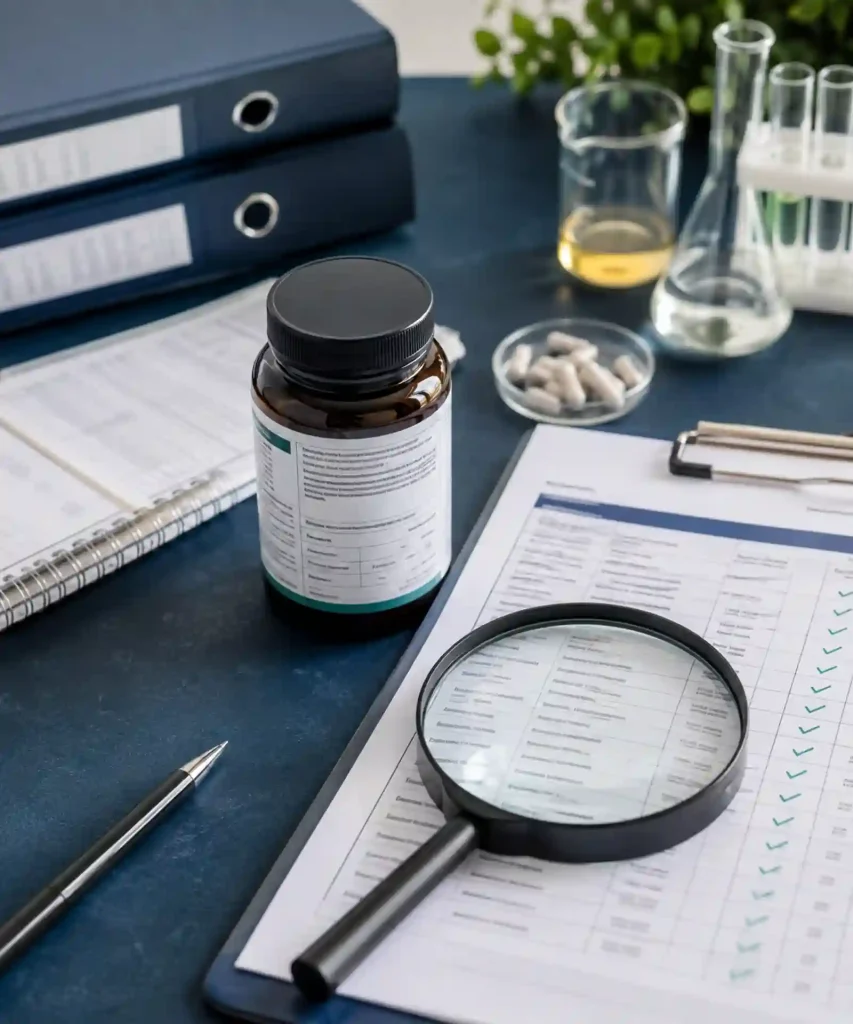
A Certificate of Analysis, or COA, records results for a specific batch against stated specifications. Depending on the product and risk assessment, documentation may include identity or potency results, microbiological testing, heavy metals, allergens, contaminants and stability or shelf-life evidence.
A generic supplier certificate is not automatically a finished-product COA. Build a technical file containing:
- final formula and manufacturing specification;
- ingredient and packaging specifications;
- supplier approvals and traceability records;
- batch manufacturing and release records;
- finished-product COAs and relevant laboratory reports;
- stability/shelf-life rationale;
- approved artwork and claim substantiation;
- food-business registration and safety-system records;
- recall procedure, complaint log and product-liabilityinsurance;
- invoices and brand-authorisation documents.
Amazon may request label images, invoices, certificates, laboratory reports or other compliance evidence, sometimes after a product has already been selling. Use the current Manage Your Compliance or Account Health process shown in Seller Central. Submit complete, matching documents: brand, product name, manufacturer, batch details and addresses should not contradict one another.
Amazon’s policies differ by marketplace. Do not automatically apply US FDA or US dietary-supplement instructions to Amazon.co.uk, and do not assume a UK-compliant product is automatically accepted in the US.
Human food supplements versus pet supplements
Pet supplements are not human foods. In Great Britain they generally fall within animal-feed law and may require feed-business registration/approval, compliant feed materials or additives, prescribed composition and analytical declarations, and animal-feed labelling. Veterinary medicinal claims can cause a product to be treated as an unauthorised veterinary medicine.
Amazon also places pet products in different categories and fee bands. If you plan to sell a dog or cat supplement, obtain advice from an animal-feed specialist and check the Veterinary Medicines Directorate, local authority and Amazon requirements separately. Do not reuse a human supplement label template.
5. Amazon Account Setup and a High-Converting Product Listing

Amazon’s Individual selling plan currently charges per item sold, while the Professional plan is £25 per month excluding VAT. A serious private-label launch normally uses the Professional plan because it supports advertising and more advanced selling tools. Amazon will verify identity and business information, so use consistent legal names, addresses, bank details and documents.
Before creating an ASIN, check the current restricted-products and food-supplement pages in Seller Central. Category or product approval may be requested, and acceptance can depend on the exact ingredient and claim set.
Build the listing from verified product facts
The detail page must agree with the physical label. Never improve the marketing by changing the dose, ingredient amount, pack count or compliant claim.
Title: Lead with the brand and accurate product type, then include the important ingredient, format, quantity or supply period where appropriate. Keep it readable and follow Amazon’s current title rules. Do not repeat synonyms or insert medical conditions.
Bullet points: Explain factual differentiators, permitted claims, amount per daily serving, format, directions and relevant dietary attributes. Put the most useful information first. Avoid guarantees, competitor attacks and unsupported superlatives.
Description: Explain who the product is for, how to use it and what is included. Keep mandatory warnings and directions consistent with the label. Formatting availability depends on the listing and Amazon interface.
Search terms: Use relevant unseen synonyms without repeating the title or adding competitor brands, misleading conditions or irrelevant traffic terms.
Product photography and A+ Content
Your main image must meet Amazon’s current image rules. Supporting images can show the bottle, capsule/tablet size, label panels, daily portion and pack contents. Lifestyle images should remain truthful; a dramatic medical-style scene can turn an otherwise cautious listing into a prohibited claim.
Show mandatory information clearly enough for distance-selling customers. Amazon’s food-product guidance expects required pre-purchase information to be supplied on the detail page, subject to limited exceptions such as durability dates that vary by unit.
Brand Registry can provide tools such as A+ Content and brand-protection features for eligible rights owners. A+ Content is useful for explaining the formula and brand story, but it remains advertising and must comply with the same food-claim rules.
6. FBA, FBM, Amazon Fees and Supplement Profit Margins

With Fulfilment by Amazon (FBA), you send prepared inventory to Amazon. Amazon stores it, dispatches orders and handles much of the customer delivery process. FBA can improve Prime convenience and reduce daily workload, but adds fulfilment, storage, inbound and possible aged-inventory or removal costs.
With Fulfilled by Merchant (FBM), you store and dispatch orders. It can suit small tests, slow-moving products, bundles or sellers with efficient existing fulfilment. You remain responsible for delivery performance, customer service and returns.
Supplements need careful stock rotation whichever method you choose. Track batch numbers and best-before dates, send stock with sufficient remaining shelf life and avoid over-ordering a product that may face a compliance review.
Current Amazon UK fee points
Amazon introduced a dedicated Vitamins, Minerals & Supplements referral-fee category. At the time of writing, the published rate is 5% for total prices up to £10 and 15% above £10, subject to a £0.25 minimum. Amazon calculates the referral fee on the total sales price.
FBA fulfilment fees depend on dimensions, shipping weight and programme eligibility. Storage is charged by volume and period. Amazon also applied a 1.5% fuel and logistics-related surcharge to UK FBA fulfilment fees from 17 April 2026. Check the current Amazon UK pricing page and Revenue Calculator for the exact ASIN before setting a price.
Example supplement profit calculation
Assume a VAT-registered seller offers one bottle at £19.99 including VAT. This deliberately simplified example uses a 15% referral fee and illustrative operating costs:
- customer price: £19.99;
- output VAT within the price: approximately £3.33;
- Amazon referral fee: approximately £3.00;
- illustrative FBA fulfilment fee: £2.70;
- product manufacturing cost: £3.25;
- packaging/label allocation: £0.45;
- inbound freight and storage allocation: £0.30;
- advertising allowance at 15% of sales: approximately £3.00;
- illustrative profit before overheads and corporation/incometax: £3.96.
That is roughly 19.8% of the VAT-inclusive customer price, or 23.8% of net sales excluding VAT. Real VAT treatment, recoverable input VAT, FBA size tier, refunds, promotions, storage and advertising will change the result. Use the free Amazon Profit Calculator with your actual quote and current Seller Central fees.
Price from the required margin backwards. Include samples, failed stock, returns, insurance, software, account fees, regulatory work and future discounts. A product that appears profitable before advertising may be loss-making during launch.
Subscribe & Save
Eligible replenishable FBA products may qualify for Subscribe & Save under Amazon’s current programme rules. It can improve repeat ordering, but discounts and funding affect margin. Treat it as a retention tool after confirming the unit economics, not as a substitute for a good product.
7. Launching, Advertising and Growing a Supplement Brand
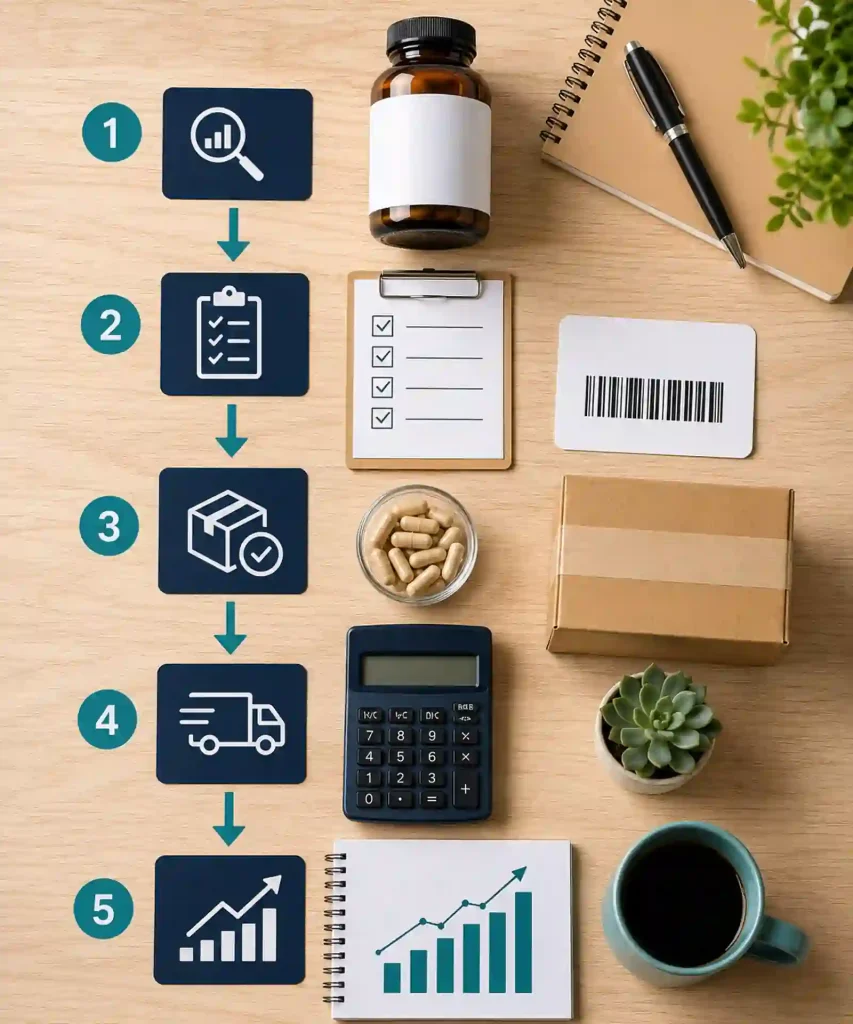
Start with a listing that is complete and compliant before sending traffic. Make sure stock is available, the buyable offer is active, images render properly and the most important keywords are indexed.
A practical launch plan
- Begin with tightly relevant Sponsored Products campaigns.
- Separate branded, exact-match, broader discovery andproduct-targeting activity.
- Set daily budgets you can sustain and monitor search-termreports.
- Negate irrelevant or unsafe medical-intent queries rather thanpaying for unsuitable traffic.
- Test the main image, price, coupon and listing clarity one change ata time.
- Track conversion, advertising cost of sales, total advertising costof sales and contribution profit—not sales alone.
Do not buy reviews, reimburse customers, ask only happy buyers for reviews or use friends and family to influence ratings. Use Amazon’s permitted Request a Review feature and eligible programmes such as Vine where available and appropriate. Product inserts may offer support, but must not manipulate review sentiment or divert negative reviewers away from Amazon.
Common mistakes when selling supplements on Amazon
- Ordering an MOQ before checking UK ingredient, label and claimscompliance.
- Copying prohibited claims from competing listings.
- Treating a manufacturer certificate as complete due diligence.
- Using “dietary supplement” on a Great Britain product instead of“food supplement”.
- Ignoring allergens, warnings, responsible-business details ordistance-selling information.
- Launching without batch-specific COAs and traceable invoices.
- Mixing US FDA guidance with Amazon UK requirements.
- Underestimating VAT, referral fees, FBA, advertising and reordercash flow.
- Letting the Amazon detail page contradict the physical label.
- Manipulating reviews or using an insert that filters unhappycustomers.
- Sending too much short-dated stock to FBA.
- Making large packaging claims that cannot be supported.
Common reasons a listing is removed or suspended
Problems often begin with prohibited medical claims, restricted ingredients, missing compliance documents, label/listing mismatches, suspected inauthenticity, expired or short-dated stock, customer safety complaints or repeated policy violations.
If Amazon removes a listing, read the exact notification and respond through the specified channel. Do not repeatedly upload random documents. Identify the root cause, correct the product or listing where permitted, and provide concise evidence. If the physical stock or label is non-compliant, a wording change online may not solve the issue.

Protecting the brand from unauthorised sellers
Secure the trade mark, GS1 identifiers, domains and social handles early. Use written manufacturing and distribution agreements, control who can buy wholesale, mark batches and retain evidence of packaging changes. Enrol eligible rights in Brand Registry and use Amazon’s reporting tools for genuine IP or authenticity problems.
An unauthorised seller is not automatically a counterfeiter. Competition law and marketplace rules matter, so avoid false infringement reports. Use test purchases and professional advice where the facts are unclear.
Scaling the range
Scale only after the first product shows repeatable contribution profit. The safest extension often serves the same customer with a related format, quantity or genuinely useful complementary product. Re-run compliance, testing, barcode and profitability work for every new SKU.
Watch cash conversion, stock cover, expiry exposure and advertising efficiency. Build sales beyond Amazon through your own website, email list or appropriate retail partners so one marketplace decision cannot stop the entire business.
8. Frequently Asked Questions and Next Steps
Amazon may require category approval or product-specific compliance information. Requirements can depend on the ingredient, claims, account and current policy. Check Seller Central’s food-supplement and restricted-products pages before buying stock.
There is no general pre-market product registration for ordinary compliant food supplements in Great Britain, but you must register the relevant food business with your local authority and comply with all applicable food law. Particular ingredients, imports and Northern Ireland sales can involve additional requirements.
Home production does not remove food-law, hygiene, traceability, safety, labelling or Amazon obligations. Your premises and processes must be suitable and registered. For most new Amazon brands, using an experienced contract manufacturer is more realistic.
Amazon can request testing and compliance documentation. A batch-specific COA is an important part of a responsible technical file, but the exact evidence Amazon requests can vary. Keep documents ready rather than waiting for a listing restriction.
Yes, if the product and account meet current requirements. You must also comply with FBA preparation, shelf-life and inventory rules. Confirm the exact product’s eligibility before sending stock.
Yes, provided the product, responsible businesses, safety, composition, label and marketing comply with the law. Putting your logo on a manufacturer’s standard product does not transfer responsibility away from you.
A straightforward stocked white-label product may take a few months. A custom formula, trade mark, testing, revised artwork and production scheduling can take much longer. Build in time for compliance corrections rather than promising a fixed date.
Choose one narrow product opportunity and create a one-page feasibility sheet covering demand, competition, permitted positioning, likely manufacturing cost, launch budget and worst-case margin. Then speak to several suitable manufacturers and a UK regulatory specialist before paying for stock.
Selling supplements on Amazon can become a valuable repeat-purchase business, but the durable advantage is not a clever claim or the cheapest bottle. It is a safe, well-documented product, a truthful listing, disciplined margins and a brand customers choose again.
Further Reading and Official Sources
- AmazonUK food supplements policy
- Amazon UK pricing andreferral fees
- FoodStandards Agency: food supplements
- GOV.UK:nutrition, health claims and supplement labelling
- GreatBritain Nutrition and Health Claims Register
- FoodStandards Agency: novel foods guidance
- GS1 UK:get a barcode
- UK IPO: search fora trade mark
- SellerSuccess:How to Sell on Amazon UK
- SellerSuccessAmazon Profit Calculator
Affiliate and AI disclosure: This article may contain affiliate links, which means I may earn a commission from qualifying purchases at no additional cost to you. AI tools may have assisted with research, drafting, editing or illustrations; all content is reviewed before publication. Read the full Affiliate and AI Disclosure.
Seller Equipment You May Need
4×6 Thermal Label Printers
Tape Guns & Parcel Tape


